
Successful DEI strategies lean into a multidimensional approach.
Respondents stressed the importance of leveraging multiple approaches to moving their strategies forward, from creating diverse candidate slates to integrating DEI for a more profound business impact. For the DEI leaders interviewed, the work begins with a defined and comprehensive strategy. Celeste Warren, vice president of the Global Diversity and Inclusion Center of Excellence at Merck, said, “Developing a strategy is just the beginning; it’s equally important to assess the infrastructure needed to drive the strategy forward and ensure its success. And, after that, it’s all about sustaining, maintaining, and adjusting when needed.”
At the 2024 I&D Impact Awards, Marvin Mendoza—global head of diversity, equity, and inclusion at PPG—shared the criteria he used to build PPG’s strategy. “I think it’s important to take into context the company that you work for, the industry that you work for, and the culture that exists.” This framework helped him create a clear focus for the team and realistic expectations about what could be achieved. He urged members to point their strategy to the place of most significant impact for the organization: “There is no shortage of things to focus on in DEI. One of the things I learned during my career about developing a strategy is that it’s more important to identify what you say, ‘No’ to versus what you say, ‘Yes’ to.” Given PPG’s journey, the team focused on representation of women globally using a multilayered approach, including predictive analytics and external benchmarks to track their progress.
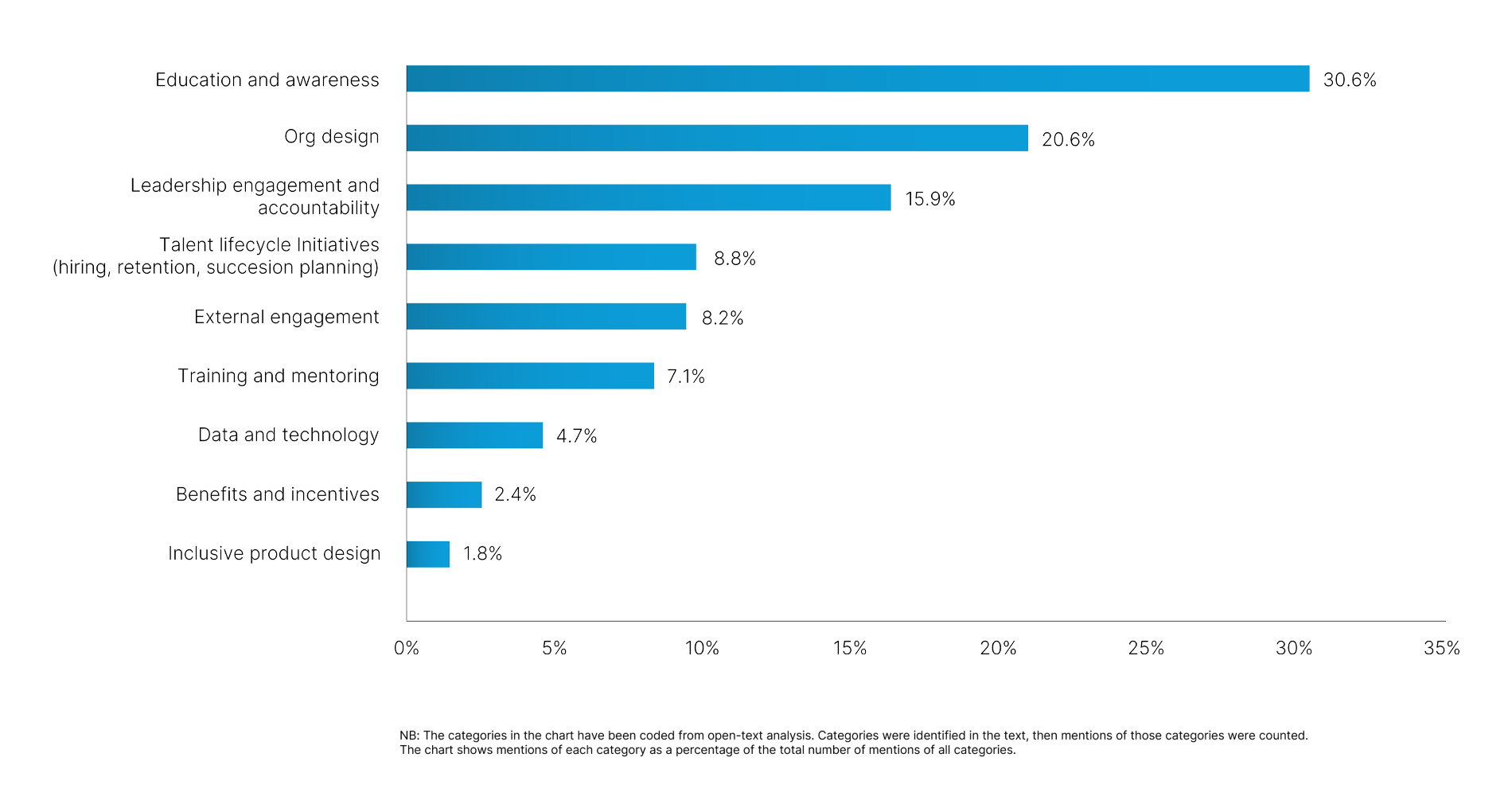
Regarding creative approaches to advancing DEI, education and awareness (31%) topped the list. There were varying perspectives on whether DEI training should be mandatory, but most leaders agreed it opens the door to greater awareness. Leaders also tailored DEI programs and curricula to fit local needs by customizing language and examples. One member said, “We flex our programs for the region, subregion, and cities where our employees and customers live and work. We want to be überlocal.”
Please share any creative approaches your organization is taking to accelerate progress toward inclusion and diversity.
Embedding DEI into the business strategy was vital for some respondents who saw momentum increase.
Gloria Goins—chief diversity, equity, and inclusion officer at Cisco—believes purpose and profit are dependent on each other, so businesses and DEI strategies should be intrinsically linked. “The goal is to build the DEI strategy with the business and curate the business’s voices into the strategy,” said Goins. “Because, at the end of the day, if you don’t have a link back to what your company is trying to drive from a business perspective, it is not sustainable.”
Oscar Health launched its “Hola Oscar” campaign, where native Spanish speakers created content to simplify health insurance benefits and connect customers with Spanish-speaking providers. Ranmali Bopitiya, EVP and chief legal officer at Oscar Health, emphasized how this initiative was a great example of connecting DEI to the business: “Everyone becomes accountable when growth projections are tied to how well we can actually meet the needs of the customers we serve.”
Those who saw an increase in momentum shared why it happened.
Increased focus and commitment to DEI
- Intentional efforts to drive hiring, retention, and leadership accountability, including tying bonuses to DEI metrics.
- Raising awareness by including revamped committees, allyship training, and shifting the conversation from diversity to inclusion.
- Deeper integration of DEI into the business, including the talent lifecycle, client interactions, and product design.
Organization structure and resource allocation
- Some organizations restructured, while others either increased centralized resources or leaned toward decentralization.
- Employee resource groups (ERGs), handbooks, and dashboards represent efforts to embed DEI into policy and practice.
- Formalization of the engagement with the CEO, board of directors, and executive leadership.
Expansion and enhancement of DEI programs
- Launch of new ERGs, expansion of existing ones, and inclusive workplace design.
- Investing in training, mentoring, and recruitment initiatives to foster inclusive environments and develop diverse talent pipelines.
- External partnerships, community engagement, awards, index ratings, and recognitions signify commitments to DEI beyond the organization.
Increased focus and commitment to DEI
- Intentional efforts to drive hiring, retention, and leadership accountability, including tying bonuses to DEI metrics.
- Raising awareness by including revamped committees, allyship training, and shifting the conversation from diversity to inclusion.
- Deeper integration of DEI into the business, including the talent lifecycle, client interactions, and product design.
Organization structure and resource allocation
- Some organizations restructured, while others either increased centralized resources or leaned toward decentralization.
- Employee resource groups (ERGs), handbooks, and dashboards represent efforts to embed DEI into policy and practice.
- Formalization of the engagement with the CEO, board of directors, and executive leadership.
Expansion and enhancement of DEI programs
- Launch of new ERGs, expansion of existing ones, and inclusive workplace design.
- Investing in training, mentoring, and recruitment initiatives to foster inclusive environments and develop diverse talent pipelines.
- External partnerships, community engagement, awards, index ratings, and recognitions signify commitments to DEI beyond the organization.
“Profit and purpose not only don’t live in separate worlds but also drive each other.”
“Profit and purpose not only don’t live in separate worlds but also drive each other.”

– Gloria Goins, chief diversity, equity, and inclusion officer, Cisco
Case Study
Hilton: Engaging Hourly Workers
A common obstacle many companies face is the involvement of hourly front-line employees in DEI efforts. Given the scheduling challenges for hourly workers, it can be tough for them to participate in DEI initiatives. DeShaun Wise Porter, vice president of diversity, inclusion, and engagement at Hilton, addresses this by organizing celebration events for each heritage month and sharing insights about them. Within two weeks of these events, the DEI team at Hilton compiles cards summarizing key insights and best practices from the programs. These cards are then distributed to all managed estates within the Hilton network, making the information available to any interested team member. By offering condensed information through these cards, “Hilton makes DEI knowledge easily accessible, thereby fostering understanding and awareness among front-line workers,” said Porter.