Internal partners, especially employee resource groups, are key to executing a DEI strategy.
In a recent conversation, one member said, “What we know from research is that when you have 25% of an organization doing any type of behavior or conduct, that 25% creates the critical mass and tipping point for cultural change.” Organizations have doubled down on decentralizing the work to include support and partnership from across the organization.
How many full-time employees do you currently have on your inclusion and diversity team, if any?
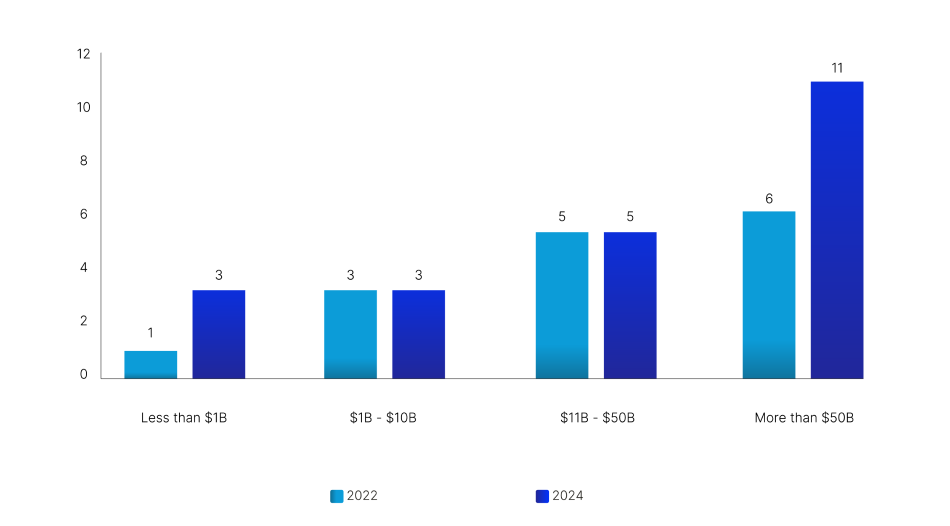
The highest average of full-time employees on a DEI team at companies with revenues over $50 billion was 11, while the overall average was four. So, the impact desired often exceeds the capabilities of the team alone. Leaders recognized that enabling employee resource groups (ERGs) is the tipping point to accelerating DEI initiatives. Tanya Spencer, chief diversity officer of GE Gas Power at GE Vernova, shared the importance of ERGs in creating community at the company. “ERGs at GE Vernova are sharing each other’s events,” she said. “They’re showing up for each other’s programs. That’s one of the ways we build allyship.”
More than half of respondents commented that they have either formalized or are actively formalizing their ERG structures to enable more impact across the organization. Companies are finding innovative ways to leverage ERGs as sounding boards to structure DEI policy, while others see value in unlocking feedback for product testing and design for specific markets. The intentional work on ERGs is creating tangible results for many organizations. One member shared, “We have gained momentum in the level of engagement in events in addition to an uptick in our overall DEI survey results year over year.”
The number of respondents who were comfortable with the size of their teams over the past year increased by 12%, and 70% of those surveyed believe their team size will stay the same over the next year. Current sentiment on talent allocations, along with employee engagement, creates an environment for DEI to thrive. According to one respondent, “DEI is part of the broader culture that we need to create as a company. The goal is to make culture a competitive advantage.”
Many DEI leaders are creating solid, impactful partnerships in supply chain, sustainability, IT, and legal functions. Ranmali Bopitiya, chief legal officer at Oscar Health, posited that everyone owns DEI: “At a company, the DEI officer is helping drive the strategy and thinking through the implementation, but the accountability is on the whole company. No one team can make that happen. You actually have to engage the whole organization to do the work.”
Case Study
Merck: Building Infrastructure to Leverage ERGs
Celeste Warren, vice president of the Global Diversity and Inclusion Center of Excellence at Merck, leverages the firm’s employee business resource groups (EBRGs) to advance diversity and inclusion initiatives.
From 2015 to 2022, membership in Merck’s 10 EBRGs experienced exponential growth, encompassing 300 chapters and 22,500 employees. These individuals are deeply integrated throughout the company and exert daily influence on their peers and managers alike.
Recognizing that approximately one-third of Merck’s workforce participates in one or more of their EBRGs, Warren understood the necessity of adding functional experts into the groups to maximize their impact. She illustrated this need by likening it to the absurdity of a manufacturing division lacking IT or HR leadership, highlighting the crucial support these experts provide to ensure operational success. Warren reached out to all the leaders of enabling functions and laid out the business case of the growth of the EBRGs. Once she conveyed the narrative and provided the data, every leader understood and readily offered the necessary support.
Merck’s EBRG infrastructure council now includes all global support functions, with a primary focus on addressing groupwide challenges.